An AI Donor Cluster in Federal Campaign Finance
Community detection on FEC contribution data
political science
networks
campaign finance
I analyzed data from the United States Federal Election Commission (FEC) on individual contributions for the 2026 election cycle. I limited the scope of the analysis to large contributions (>$3,000) to candidate committees for those running for House, Senate, or President.
The goal of this exploratory analysis is to identify patterns and communities among donors. For individual contributions, since contribution limits cap how much one donor can give, for candidates to raise large amounts of cash, they need to court many donors. This may include ‘bundlers,’ who coordinate many individual donors to funnel large amounts of money to their preferred candidates.
To find patterns and potentially detect bundling, I structured the data as a network. Each donation over $3,000 is a link between a donor and a candidate, and I projected these links into donor-donor connections: if two donors give over $3,000 to the same candidate they are linked, links are discarded if there are fewer than three candidates in common, and these links are weighted by the number of shared candidates.
The cluster
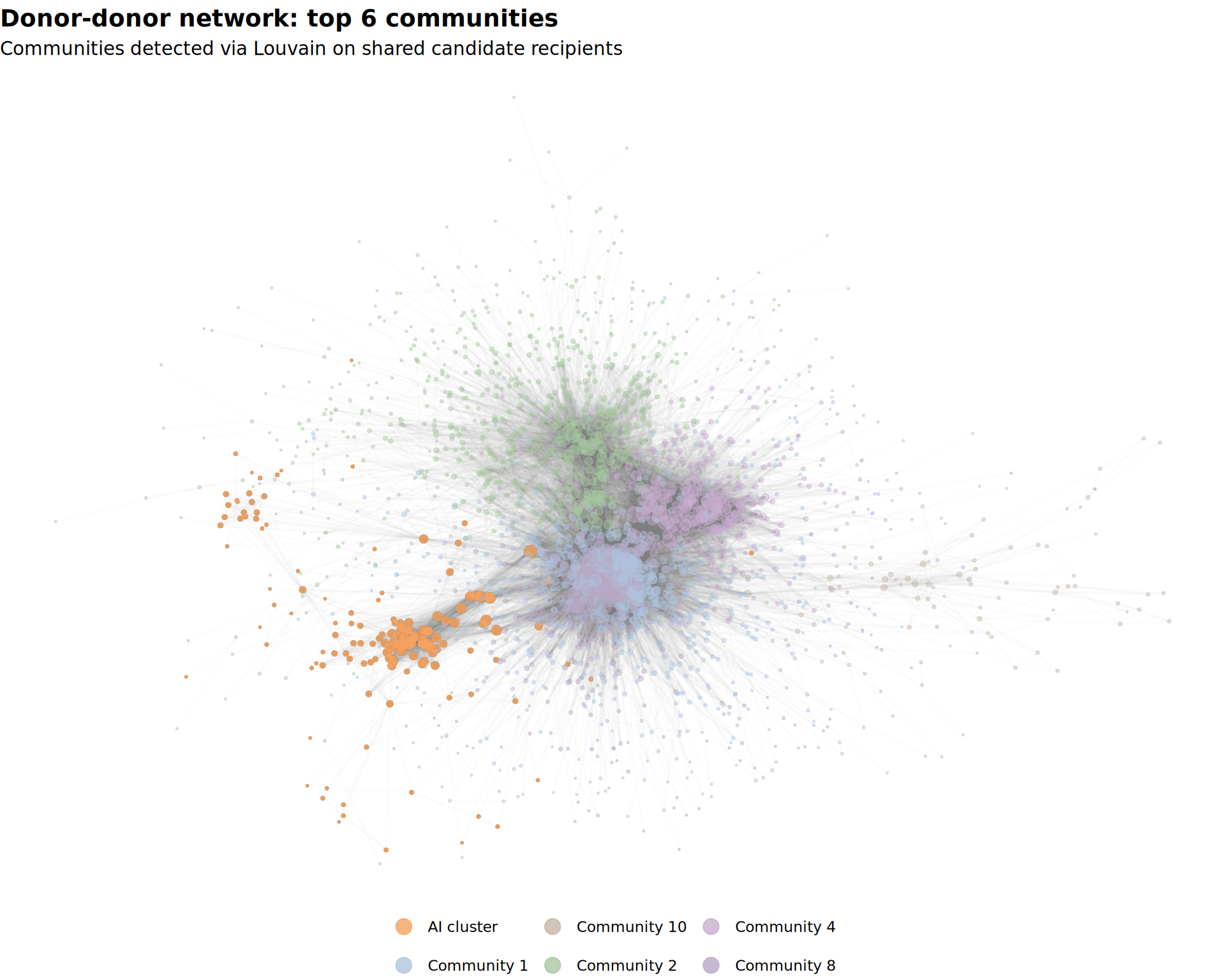
Louvain community detection (Blondel et al. 2008) on a donor-donor projection of FEC contribution data (edges where two donors share 3+ candidate recipients) identified 77 communities. One community has a notably high concentration of AI industry employees.
Where the money goes
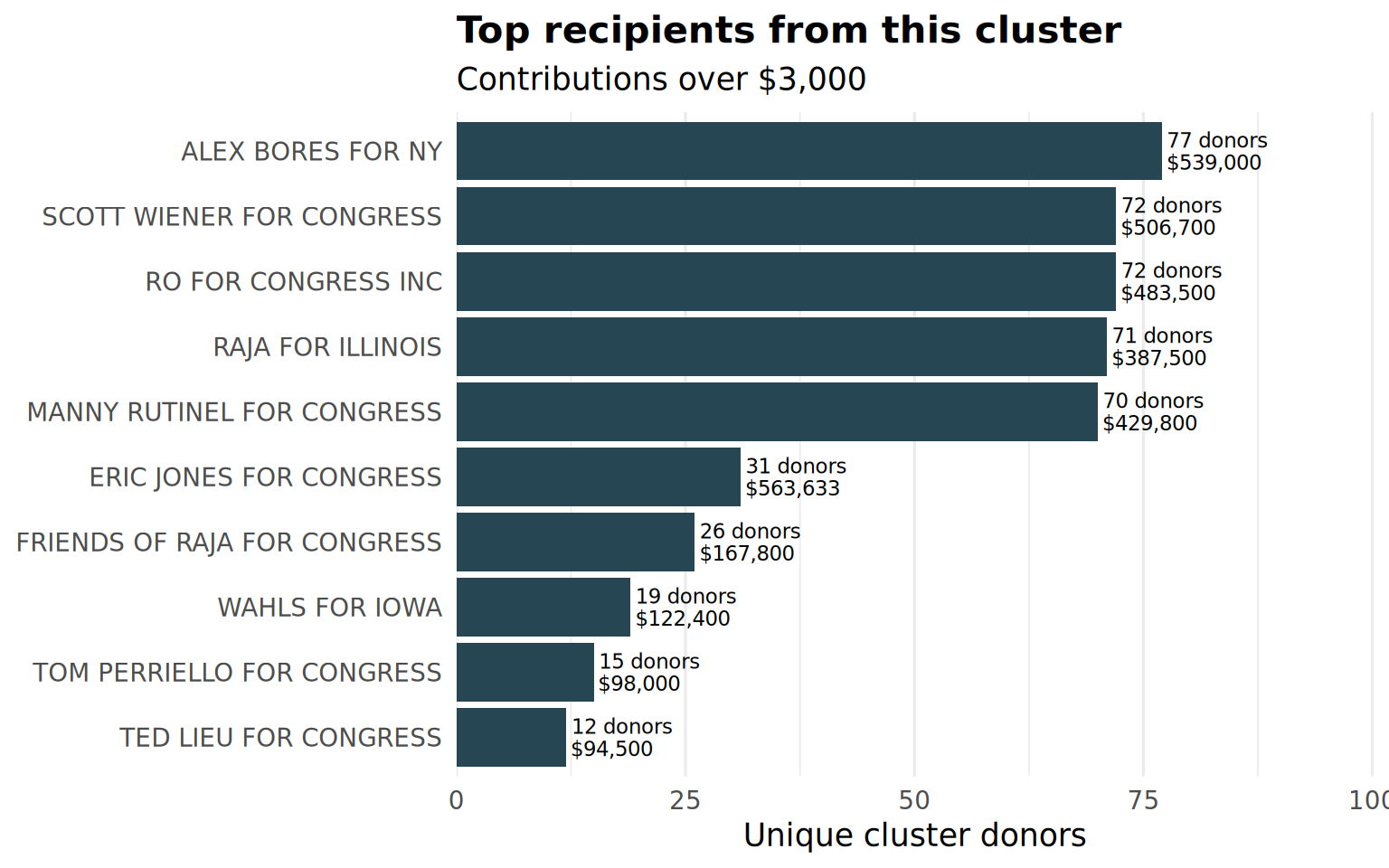
The top recipient of donations from this cluster is Alex Bores. Bores has drawn attention for the AI-related PACs spending both for and against him (Wilkins 2026). This analysis reveals financial support from individuals in the AI industry as well.
All amounts from contributions over $3,000.
| Candidate | Donors | Contributions | Total |
|---|---|---|---|
| ALEX BORES FOR NY | 77 | 154 | $539,000 |
| SCOTT WIENER FOR CONGRESS | 72 | 142 | $506,700 |
| RO FOR CONGRESS INC | 72 | 135 | $483,500 |
| RAJA FOR ILLINOIS | 71 | 111 | $387,500 |
| MANNY RUTINEL FOR CONGRESS | 70 | 121 | $429,800 |
| ERIC JONES FOR CONGRESS | 31 | 59 | $563,633 |
| FRIENDS OF RAJA FOR CONGRESS | 26 | 49 | $167,800 |
| WAHLS FOR IOWA | 19 | 35 | $122,400 |
| TOM PERRIELLO FOR CONGRESS | 15 | 28 | $98,000 |
| TED LIEU FOR CONGRESS | 12 | 25 | $94,500 |
| LICCARDO FOR CONGRESS | 11 | 17 | $58,700 |
| RAKHI ISRANI FOR CONGRESS | 9 | 16 | $56,000 |
| HICKENLOOPER FOR COLORADO | 9 | 15 | $52,500 |
| FRIENDS FOR GREGORY MEEKS | 7 | 12 | $41,800 |
| NEIL FOR CONGRESS | 7 | 7 | $24,500 |
Most connected donors
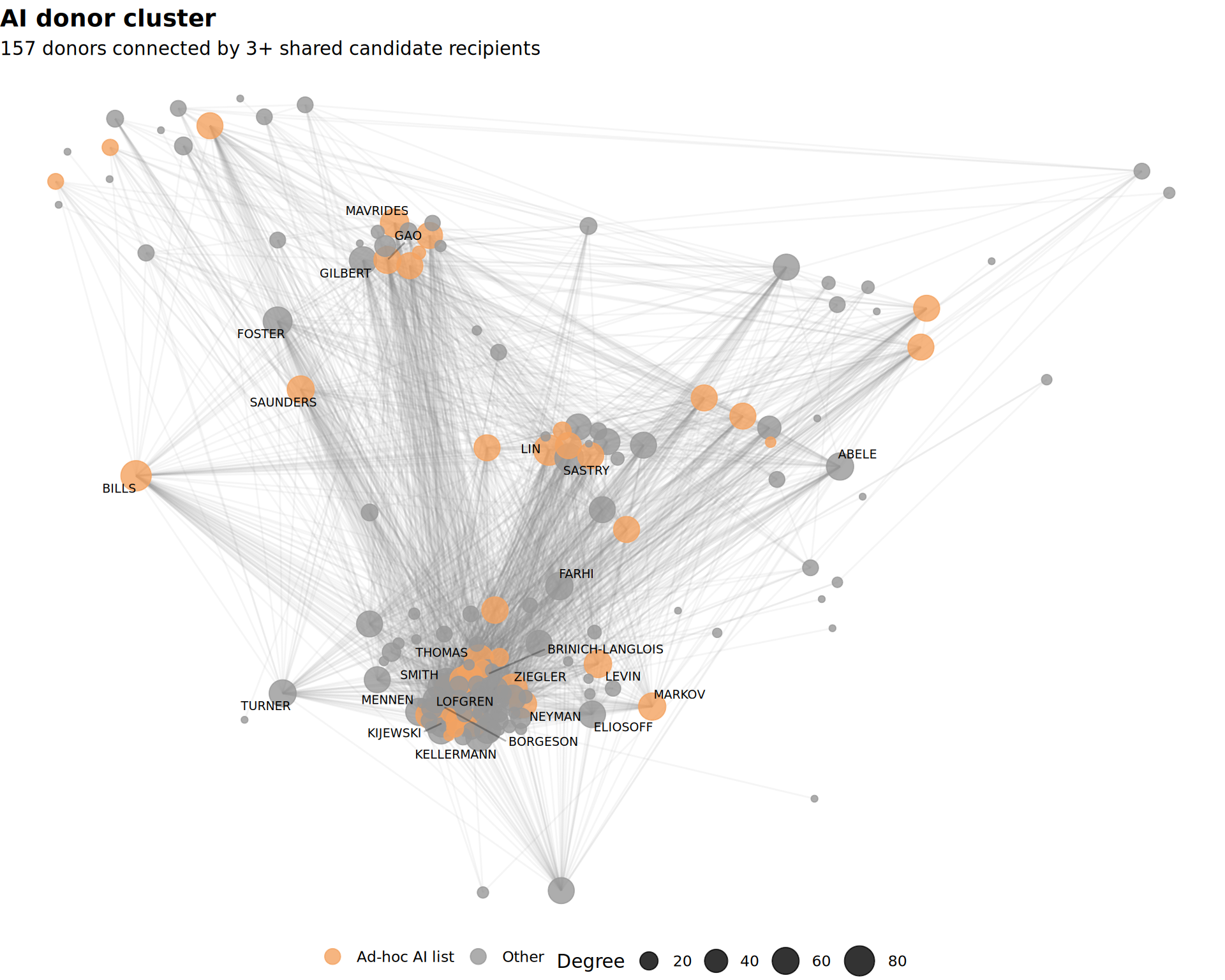
Degree = number of other cluster members who share at least 3 candidate recipients. Contributions and totals from contributions over $3,000.
| Donor | Employer | Degree | Betweenness | Contributions | Total |
|---|---|---|---|---|---|
| BILLS, STEVEN | ANTHROPIC | 82 | 3479.76 | 43 | $154,000 |
| LIN, TAO | ANTHROPIC | 82 | 983.43 | 30 | $111,856 |
| ZIEGLER, DANIEL | ANTHROPIC | 77 | 866.80 | 35 | $128,000 |
| FOSTER, LAUREN | AGE BOLD | 72 | 66.98 | 21 | $73,500 |
| THOMAS, DRAKE | ANTHROPIC | 72 | 310.85 | 17 | $59,500 |
| LOFGREN, PETER | ANTHROPIC | 71 | 81.12 | 18 | $71,100 |
| SASTRY, GIRISH | GIRISH SASTRY | 71 | 77.87 | 21 | $80,500 |
| BRINICH-LANGLOIS, PATRICK | ACADEMIA.EDU | 70 | 137.15 | 13 | $44,900 |
| MAVRIDES, DYLAN | JANE STREET | 69 | 29.63 | 11 | $38,100 |
| KIJEWSKI, JOSEPH | EVERLAW | 67 | 20.23 | 13 | $45,500 |
| BORGESON, BLAKE | SELF EMPLOYED | 65 | 39.40 | 12 | $42,000 |
| FARHI, DAVID | SAFE SUPERINTELLIGENCE | 63 | 11.79 | 13 | $45,500 |
| GILBERT, JESSE | CIVAI | 63 | 34.24 | 9 | $31,500 |
| LEVIN, TREVOR | OPEN PHILANTHROPY | 63 | 5.79 | 6 | $21,000 |
| ABELE, EMMA | PROTECTIVE EQUIPMENT INC. | 62 | 10.81 | 12 | $49,000 |
| KELLERMANN, ANTONY | SELF EMPLOYED | 62 | 10.81 | 11 | $38,500 |
| MARKOV, TODOR | OPENAI | 62 | 11.50 | 25 | $90,600 |
| MENNEN, ALEX | PURE STORAGE | 62 | 10.81 | 10 | $34,900 |
| NEYMAN, ERIC | ARC | 62 | 10.81 | 12 | $47,800 |
| SMITH, MICHAEL | CORNERSTONE RESEARCH | 62 | 316.00 | 32 | $122,100 |
Who’s in it
| Employer | Donations | Donors | Total |
|---|---|---|---|
| ANTHROPIC | 124 | 13 | $448,700 |
| NOT EMPLOYED | 124 | 36 | $439,800 |
| SELF EMPLOYED | 55 | 23 | $193,900 |
| ANTHROPIC PBC | 54 | 6 | $194,356 |
| OPENAI | 38 | 7 | $143,000 |
| (blank) | 33 | 28 | $127,500 |
| 30 | 5 | $105,000 | |
| OPEN PHILANTHROPY | 29 | 6 | $102,800 |
| SELF-EMPLOYED | 28 | 11 | $110,600 |
| N/A | 22 | 14 | $77,000 |
| SELF | 21 | 9 | $77,000 |
| AI LAB WATCH | 19 | 1 | $73,500 |
| WANXIANG AMERICA CORPORATION | 16 | 1 | $59,500 |
| KAITAR RESOURCES | 15 | 1 | $63,000 |
| AVERI | 15 | 1 | $51,443 |
| ELECTRIC CAPITAL | 14 | 1 | $49,000 |
| SAFE SUPERINTELLIGENCE | 13 | 1 | $45,500 |
| EVERLAW | 12 | 1 | $42,000 |
| XYZ VENTURE CAPITAL | 12 | 1 | $42,000 |
| ALIGNMENT RESEARCH CENTER | 11 | 1 | $41,200 |
| CENTRE FOR EFFECTIVE ALTRUISM | 11 | 2 | $38,500 |
| NESSEL DEVELOPMENT | 11 | 1 | $37,950 |
| CONFUSION CAPITAL | 10 | 1 | $38,500 |
| GIRISH SASTRY | 10 | 1 | $35,000 |
| PURE STORAGE | 10 | 1 | $34,900 |
The network
Geography
| State | Donors |
|---|---|
| CA | 95 |
| IL | 18 |
| NY | 11 |
| MA | 7 |
| TX | 6 |
| DC | 5 |
| FL | 3 |
| WA | 2 |
| AZ | 1 |
| CO | 1 |
| CT | 1 |
| DE | 1 |
| GA | 1 |
| MO | 1 |
| NM | 1 |
| NV | 1 |
| PA | 1 |
| VA | 1 |
This cluster is mostly California-based, despite Bores’ location in New York.
Timing
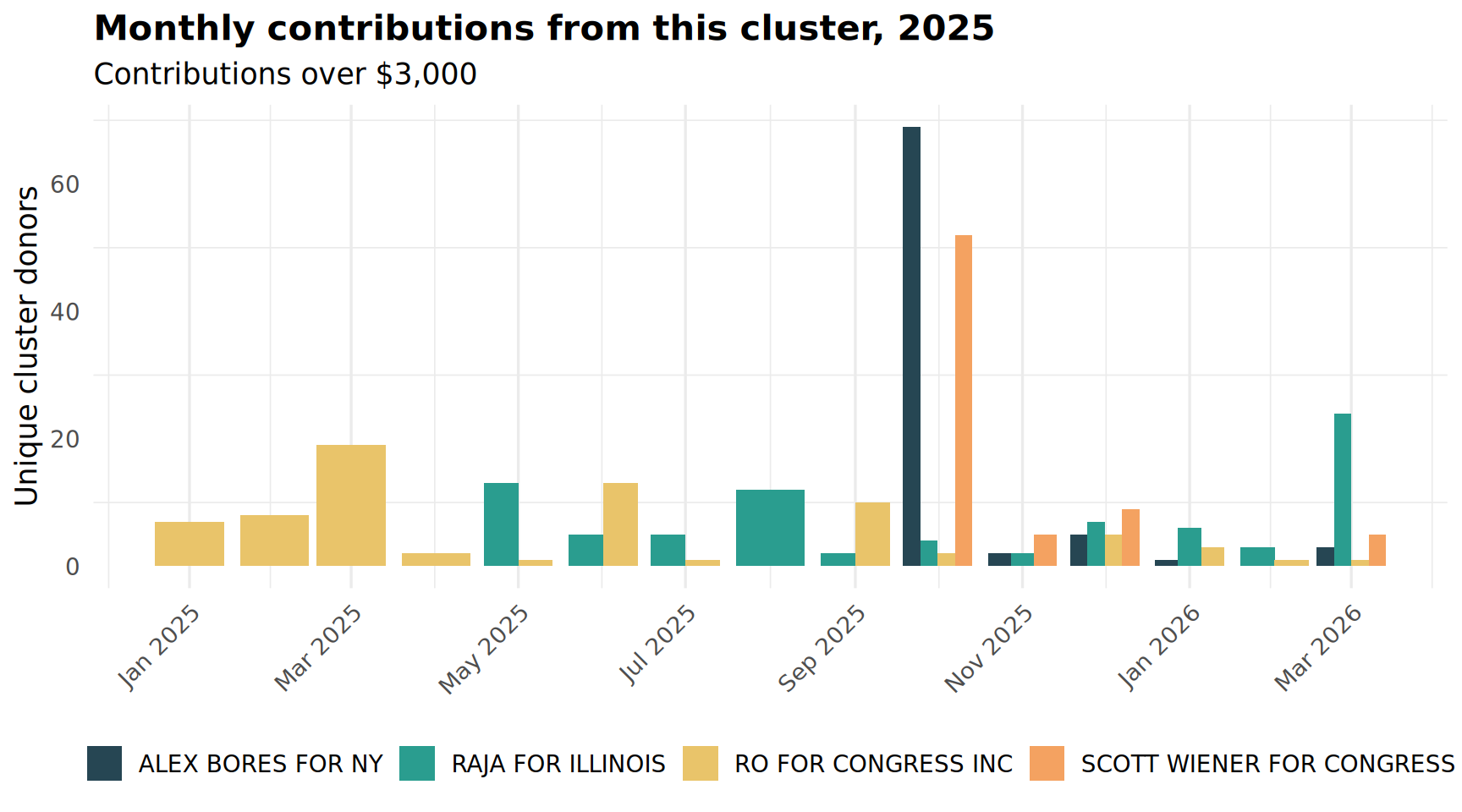
The Bores donations from this cluster mostly occur in October 2025. This suggests a shared impetus for the donations rather than just an ideological alignment.
Caveats
- Donor identity is name-only. Two people with the same name in different states are conflated; the same person with different spellings is split.
- Louvain resolution is fixed at 1.0 (the default). Community structure is sensitive to this parameter. These communities have not been tested for stability across resolutions.
- Structural patterns, not proof of coordination. Community detection identifies donors with similar giving patterns. It does not establish that giving was coordinated.
- All dollar amounts are from individual contributions over $3,000 to candidate-authorized committees (FEC types H, S, P). The federal per-election contribution limit is $3,300 (2023–2024) / $3,500 (2025–2026); the $3,000 threshold is approximate.
References
Bates, Douglas, Martin Maechler, and Mikael Jagan. 2026. Matrix: Sparse and Dense Matrix Classes and Methods. https://doi.org/10.32614/CRAN.package.Matrix.
Blondel, Vincent D., Jean-Loup Guillaume, Renaud Lambiotte, and Etienne Lefebvre. 2008. “Fast Unfolding of Communities in Large Networks.” Journal of Statistical Mechanics: Theory and Experiment 2008 (10): P10008. https://doi.org/10.1088/1742-5468/2008/10/P10008.
Csárdi, Gábor, Tamás Nepusz, Vincent Traag, et al. 2026. Igraph: Network Analysis and Visualization. https://r.igraph.org/.
Mühleisen, Hannes, and Mark Raasveldt. 2026. Duckdb: DBI Package for the DuckDB Database Management System. https://r.duckdb.org/.
Pedersen, Thomas Lin. 2024. Tidygraph: A Tidy API for Graph Manipulation. https://tidygraph.data-imaginist.com.
Pedersen, Thomas Lin. 2025. Ggraph: An Implementation of Grammar of Graphics for Graphs and Networks. https://ggraph.data-imaginist.com.
R Core Team. 2026. R: A Language and Environment for Statistical Computing. R Foundation for Statistical Computing. https://doi.org/10.32614/R.manuals.
Wilkins, Emily. 2026. “Dueling PACs Take Center Stage in Midterm Elections over AI Regulation.” CNBC, February 19. https://www.cnbc.com/2026/02/19/dueling-pacs-take-center-stage-in-midterm-elections-over-ai-regulation.html.
Data: FEC individual contributions (bulk files). Analysis conducted in R with igraph, tidygraph, and ggraph.